
Meowdoku vs LinkedIn Queens: Same Rules, Different Games
By sosojustdo · Published · 9 min read
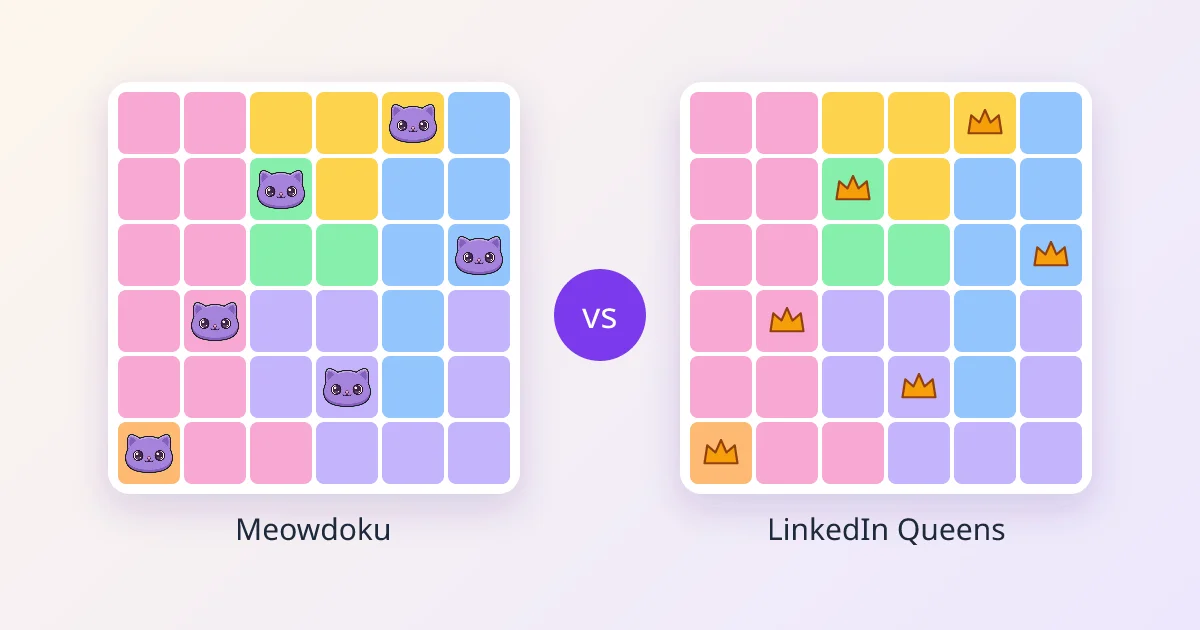
Meowdoku and LinkedIn Queens are the same puzzle wearing different clothes. Both ask you to place one piece in every row, every column, and every colored region, with no two pieces touching, even diagonally. That's the one-star form of the classic Star Battle puzzle. The difference between Meowdoku and LinkedIn Queens isn't the logic. It's how you play: Queens gives everyone one shared board a day and ranks you against your network, while Meowdoku gives you as many boards as you want and hints that explain the next step. Which is harder depends on the board size, not the brand.
Are Meowdoku and LinkedIn Queens the same game?
By the rules, yes. Line them up:
| Rule | Meowdoku | LinkedIn Queens |
|---|---|---|
| One per row | One cat | One crown |
| One per column | One cat | One crown |
| One per colored region | One cat | One crown |
| No touching | Not even diagonally | Not even diagonally |
LinkedIn launched Queens in May 2024 alongside Pinpoint and Crossclimb, and FOX's launch coverage summed up the goal as placing one "queen" per row, column, and colored region. Both games inherit those rules from Star Battle; the puzzle-star-battle.com rule sheet puts the one-star version as "1 star on each row, column and shape," with stars never adjacent "horizontally, vertically or diagonally." If you want the full walkthrough with a worked board, read the full rules.
One thing worth clearing up: "Meowdoku" isn't a single product. There's the Meowdoku! mobile app by Oakever Games, and there are browser versions, including this one, Meowdoku.run, which I build and which isn't affiliated with the app. They share the rules, but board sizes, modes, and features differ. Everything below about Meowdoku refers to Meowdoku.run unless I say otherwise.
Side-by-side: Meowdoku vs LinkedIn Queens
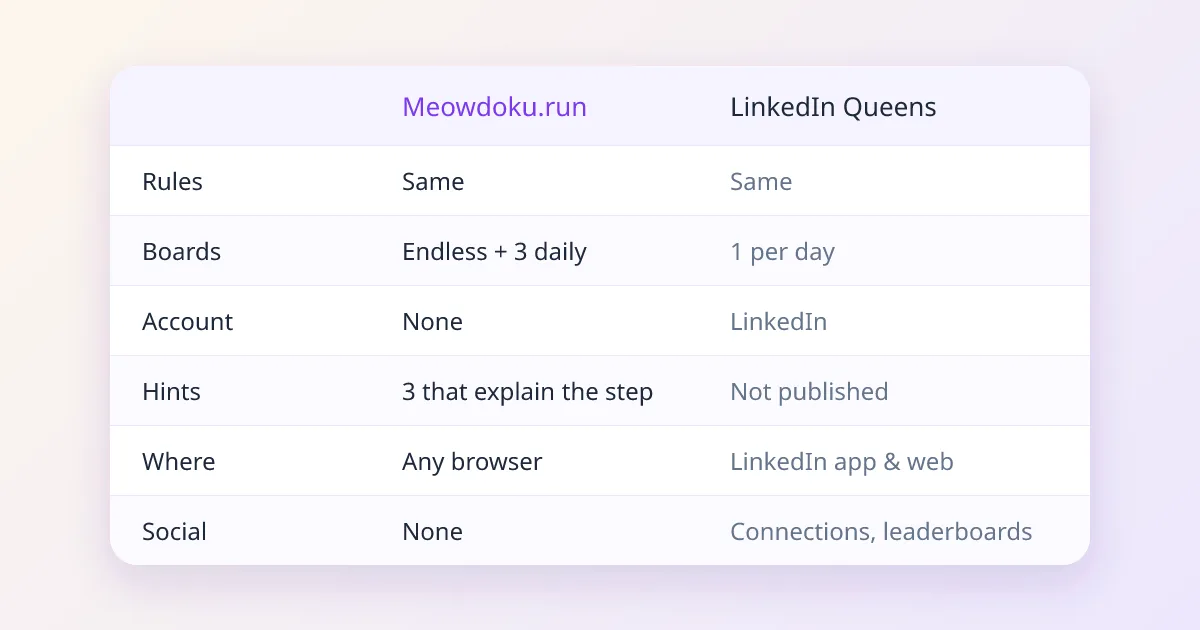
| Meowdoku.run | LinkedIn Queens | |
|---|---|---|
| Piece | Cats | Crowns |
| Boards | Endless, plus 3 daily boards | One shared board per day |
| Board sizes | 6×6, 7×7, 8×8 | Not published |
| Account | None | LinkedIn account |
| Where | Any browser | LinkedIn app and website |
| Mistakes | 3 hearts per board | Not published |
| Hints | 3 per board, each explains the deduction | Not published |
| Social | None; best times stay on your device | Shows which connections played; company and school leaderboards |
| Ads | A few banners and native ads, never over the board | No ad slots on the game page when I checked (Oct 2026) |
Where a row says "not published," I couldn't find an official LinkedIn source, so I'm not guessing.
The real difference: one board a day vs as many as you want
LinkedIn built Queens around connection. FOX's launch piece explains that after you play you can see which of your connections played that day, and that results "tally up on a company and school leaderboard." Each puzzle is meant to take a few minutes. When I opened the game on October 10, 2026, it was showing puzzle No. 893.
That design is great for a habit. It's less great for getting better. If a technique finally clicks on Tuesday's board, you wait until Wednesday to try it again.
Meowdoku goes the other way. Endless boards in three sizes mean you can repeat the same idea ten times in ten minutes, and today's daily boards give you a shared set when you want one. There's no leaderboard, though. If comparing scores with coworkers is the point for you, Queens wins that one outright.
Which one is harder?
Neither, by rule. Difficulty comes from two things: how big the board is, and how the regions are drawn.
To put numbers on the size effect, I generated 1,500 Meowdoku boards (500 each at 6×6, 7×7, and 8×8) and solved every one with the same engine that runs the in-game hints, allowing only single-step deductions.
| Board | Solved with single-step deductions only |
|---|---|
| 6×6 | 89.4% |
| 7×7 | 85.4% |
| 8×8 | 70.4% |
So the jump from 7×7 to 8×8 matters more than the jump from 6×6 to 7×7: on 8×8, about three boards in ten need something deeper than a one-step move. Bigger boards in either game push in the same direction. One YouTube commenter put it bluntly about the Meowdoku! app: "It's basically Queens but much harder since they usually do 10x10 grids." That's one player's view of the app, not something I measured — but it points the same way as the numbers.
What actually solves a board: the deduction mix
Across those same 1,500 boards, I also logged which kind of deduction each hint step used.
| Deduction | 6×6 | 7×7 | 8×8 |
|---|---|---|---|
| Single open cell left in a row, column, or region | 36.3% | 36.3% | 34.2% |
| Crossing out cells a placed cat covers | 28.3% | 29.9% | 29.5% |
| Dead-end cells (a cat here would empty another region) | 16.9% | 16.2% | 18.9% |
| Region–line locks | 17.8% | 16.7% | 15.7% |
| Reveal (no single step left) | 0.7% | 0.9% | 1.7% |
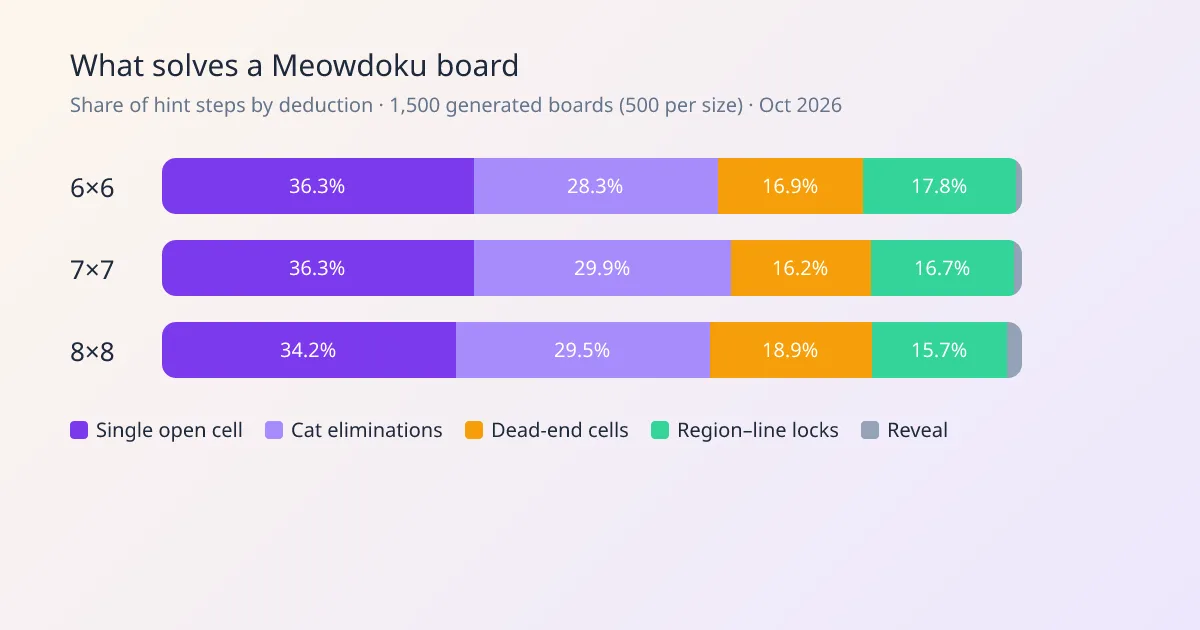
Three things stand out.
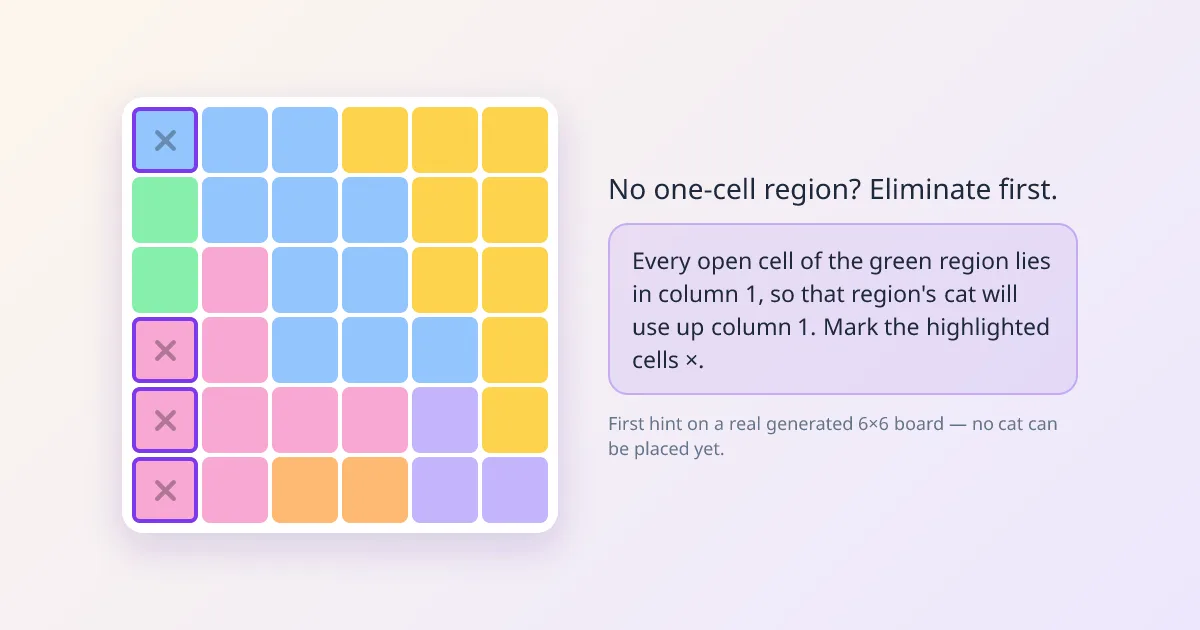
Your first move depends on one thing: a one-cell region. On 63.4% of 6×6 boards, 69.4% of 7×7, and 72.2% of 8×8, the very first deduction was a cat — and in every one of those boards, it was because some region was a single cell. On the boards without one, the first cat only appeared after an average of 5.5 to 6.8 crossing-out steps, and up to 20. So scan for a one-cell region first. If there isn't one, stop looking for a cat and start eliminating.
Look-ahead jumps on 8×8. Dead-end cells — "if a cat sat here, that region would have nowhere left" — sit around 16–17% of steps on 6×6 and 7×7, then rise to 18.9% on 8×8. That's the move most people find hardest, because it asks you to test a cell in your head instead of reading the board.
Line locks are steady. About one step in six, at every size, is a region squeezed into a single row or column. It's the highest-leverage habit to build, and it works identically in both games.
Strategies that transfer between both games
Because the rules match, every technique you learn in one game works in the other:
- Check for a one-cell region, then eliminate. If a region is a single cell, that's your first cat. If not, expect around six crossing-out steps before the first cat appears.
- Find the squeezed region. If a region's open cells all sit in one row or column, that line belongs to it. These region line-locks make up roughly a sixth of all steps.
- Clean up after every cat. Crossing out a new cat's row, column, region, and eight neighbors is almost 30% of the work. Skip it and you'll miss the next single cell.
- Test the tempting cell. Before committing on a big board, ask whether that cat would leave some region empty.
- Watch the diagonals. Two pieces in different rows and columns can still touch at a corner. It's an easy way to lose a heart in Meowdoku and an easy thing to miss in Queens.
If you want something with these exact rules but a different setting, I've covered the whole family in games like Meowdoku.
Which should you play?
- You want a two-minute daily ritual and to compare with coworkers: LinkedIn Queens.
- You want to practice until a technique sticks: Meowdoku, with endless boards.
- You're stuck and want to understand why: Meowdoku's hints explain the deduction rather than placing a cat for you.
- You don't want another account: play Meowdoku free in your browser.
- Both: they're the same puzzle, so one makes you better at the other.
Frequently asked questions
Is Meowdoku a copy of LinkedIn Queens?
Both use the rules of Star Battle, an older pencil-and-paper logic puzzle, in its one-star form: one piece per row, column, and colored region, and no two pieces touching. Meowdoku swaps the crowns for cats and changes how you play — unlimited boards and explained hints instead of one shared board a day.
Is Meowdoku harder than LinkedIn Queens?
Not by its rules, which are identical. Difficulty comes from board size and layout. On Meowdoku.run, 89.4% of 6×6 boards can be solved with single-step deductions alone, falling to 70.4% at 8×8, so bigger boards are where you start needing look-ahead.
Can I play LinkedIn Queens without an account?
Queens lives inside LinkedIn, so playing and keeping your streak and leaderboard position requires a LinkedIn account. Meowdoku.run needs no account at all.
Can I play more than one Queens-style puzzle a day?
LinkedIn publishes one Queens board per day. Meowdoku.run has endless boards in 6×6, 7×7, and 8×8, plus its own three daily boards, so you can play as many as you like.
References
- FOX TV Digital, LinkedIn adds 3 games to spark conversation and connection, May 4, 2024.
- LinkedIn, Queens (official game page; puzzle No. 893 on Oct 10, 2026).
- puzzle-star-battle.com, Star Battle rules.
- Krazydad, Star Battle Puzzles.
- YouTube comment on How to Play This New Addictive Puzzle Game | Queens Tutorial (player opinion about the Meowdoku! app).
- Meowdoku data: 1,500 boards generated and solved by the in-game hint engine on 2026-10-10 (500 each at 6×6, 7×7, 8×8); deduction mix, opening and solvability scripts are kept with the site source.
Ready to place some cats?
Endless boards, three daily puzzles, and hints that explain the next step.