
How to Play Meowdoku
Last updated:
Meowdoku is a cat-themed logic puzzle in the style of Sudoku and the Queens puzzle. Despite the "cat Sudoku" nickname, you never write numbers and you don't fill in the whole grid — you simply place a few cats in exactly the right spots, using logic alone.
The goal of Meowdoku
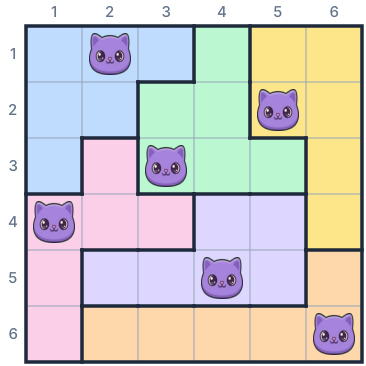
Place a single cat in every row, every column, and every colored region — and make sure no two cats ever touch. On a 6×6 board that means just six cats in total; most cells stay empty. When all the cats are placed correctly, the puzzle is solved.
The rules of Meowdoku
Every Meowdoku board follows the same four rules, so learning them once lets you solve any board you meet:
- Every row contains exactly one cat.
- Every column contains exactly one cat.
- Every colored region contains exactly one cat.
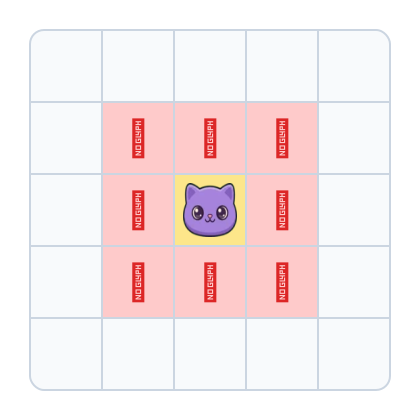
- No two cats may touch — not horizontally, vertically, or even diagonally. Once a cat is placed, all eight cells around it are off-limits.
How Meowdoku differs from Sudoku
If you expect classic Sudoku, three things will surprise you:
- No numbers, no math. You place cats, not digits — it is pure pattern logic.
- You don't fill the grid. Sudoku fills every cell; Meowdoku places just one cat per row, column, and region, so most cells stay blank.
- Cats can't touch. This adjacency rule — including the diagonals — doesn't exist in Sudoku, and it's the heart of the puzzle. It comes from the Queens puzzle, which Meowdoku is built on.
One more thing worth knowing: every board here is generated with a guaranteed single solution you can always reach by reasoning — you never have to guess.
A full worked example: solving a board step by step
Rules click into place once you see them in motion, so here is one complete 6×6 board solved from start to finish. Every move below is forced — there is never a guess. Follow along on the grids; the numbers match the row and column labels, and each region has its own color.
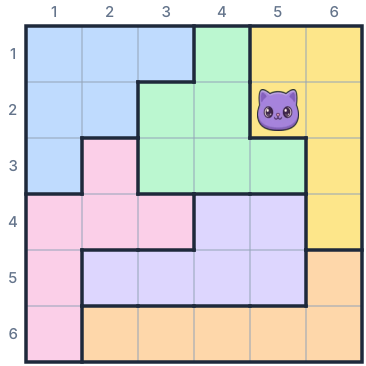
- Start from the locked cat — row 2, col 5 (yellow). It immediately rules out its entire row and column, the eight cells touching it, and every other cell in its yellow region.
- Green region → row 3, col 3. Every other green cell is already gone: the top ones share row 2 or touch the locked cat, and the right-hand one sits in column 5. One green cell survives, so the cat must go there.
- Row 4 → col 1 (pink region). In row 4, columns 5–6 are dead (the locked cat's column and region), columns 3–4 are blocked by the green cat, and column 2 touches it diagonally. Only column 1 is left open.
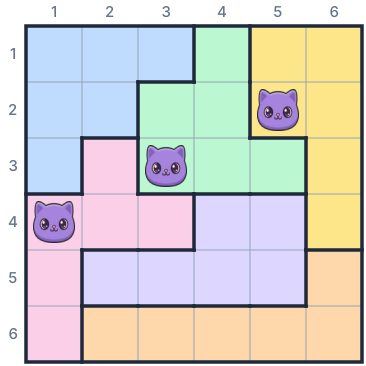
- Blue region → row 1, col 2. Row 2 is the locked cat's row, column 1 now belongs to the pink cat, and column 3 was cleared by the green cat — leaving a single blue cell at row 1, col 2.
- Violet region → row 5, col 4. Its upper cells sit in the now-dead row 4, columns 2–3 are gone, and column 5 is the locked cat's column. Row 5, col 4 is the only gap.
- Orange region → row 6, col 6. Only the orange region is left, and every cell except row 6, col 6 has been eliminated. The last cat lands there and the board is complete.
Notice we never guessed once. At every step exactly one cell was legal for some region, row, or column — find that forced move, place the cat, and the next one usually appears. That is the rhythm of every Meowdoku board.
Try a Meowdoku board now
The fastest way to learn is to place a few cats yourself. Here is a live board — pick a difficulty and try the steps above:
Tap a cell to cycle empty → ✕ →  . One cat per row, column & color region — and no two cats may touch, not even diagonally.
Playing the game
Here is everything you need to play a board hands-on — the controls, how you win or lose, and how to read the counters around the grid.
Controls
Tap a cell to cycle through three states: empty → ✕ (your own note that a cat can't go there) → (a placed cat) → empty again. The ✕ mark is just a memory aid; only cats are checked against the rules.
How you win and lose
You win by completing the board and lose by running out of hearts — here is exactly how each one works:
- Win: place the full set of cats with every row, column, and region holding exactly one, and no two cats touching.
- Lose: you have three hearts. Placing a cat that breaks a rule costs one heart, and losing all three ends the round — but you can retry instantly.
Reading the board
Three small indicators around the board let you see how you are doing at a glance:
- ❤️ Lives (top left): your three hearts. Each rule- breaking placement removes one.
- ⏱ Timer (middle): how long you've spent on the current puzzle. Solve it to set your best time.
- 🐾 Cats placed (top right): how many cats you've placed out of the total needed to finish the board.
Meowdoku game modes
Meowdoku gives you two ways to play, both free in your browser and built on the same rules:
- Endless: an unlimited stream of freshly generated puzzles. Pick Easy, Normal, or Hard and play as many as you like.
- Daily: three fixed boards per day — one per difficulty — the same for everyone, rolling over at midnight UTC. Come back each day to beat your time.
Both modes are tabs on the homepage board.
Once the rules click, the next thing to learn is how to find the forced cat without guessing. The Meowdoku tips & strategy guide covers region line-locks, adjacency cascades, negative space, locked pairs, and the diagonal-touch trap that costs most players their hearts.
Playing the mobile app's numbered campaign instead? The Meowdoku levels guide explains how the level numbers, board sizes, and difficulty relate — and why the same level can look different on two phones.
Meowdoku rules: frequently asked questions
- Is Meowdoku the same as Sudoku?
- No. It shares Sudoku's deductive feel, but you place cats instead of writing numbers, you don't fill the whole grid, and cats can never touch — not even diagonally. That no-touching rule comes from the Queens puzzle and doesn't exist in Sudoku.
- How many cats are on the board?
- Exactly one cat per row, one per column, and one per colored region. On a 6×6 board that works out to six cats placed correctly; the rest of the cells stay empty.
- What are the rules of Meowdoku?
- Place one cat in every row, every column, and every colored region, and never let two cats touch — not horizontally, vertically, or diagonally. When all cats are placed correctly the puzzle is solved.
- How do you play Meowdoku step by step?
- Find the most constrained region, row, or column — the one with the fewest open cells — and place a cat there. Mark the eight cells around it with ✕ so nothing can touch it, then repeat: each placement forces the next cat.