
Meowdoku Tips & Strategy
Last updated:
You know the rules — now solve faster and stop losing hearts. These are the techniques that turn Meowdoku from trial-and-error into pure deduction, from the everyday 6×6 board up to the harder 8×8. New here? Start with the rules and basics first.
Core deduction techniques
These moves find forced placements, so you solve the board by logic instead of trial and error.
Always start where you have the fewest choices
The single habit that separates fast solvers from slow ones is move order. Don't start in the middle of the board — scan for the most constrained spot: the smallest colored region, or the row or column that already has the fewest open cells. The tighter a spot is, the more certain your move, and a certain move never costs a heart.
Region line-locks: claim a whole row or column
This is the highest-leverage technique in the game. If a region's only open cells all sit in one row (or one column), that region's cat must go somewhere in that line — even though you don't yet know which cell. That means the line is reserved: no other region's cat can use it, so you can immediately rule out every other cell in that row or column.
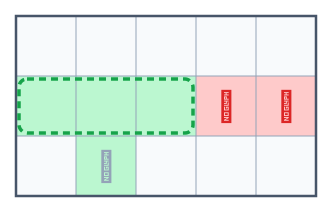
Adjacency cascades: one cat forces the next
The no-touching rule is not just a constraint to obey — it's a weapon. Every cat you place blocks the eight cells around it. Those dead cells often empty out a neighbouring region until it has just one legal square left, handing you the next cat for free. Chase that chain: place, block the neighbours, look for the region you just squeezed.
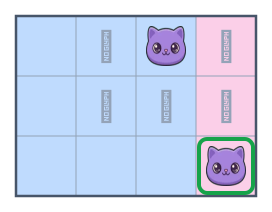
Think in negative space
When you stall, you are usually asking the wrong question. Instead of "where does this cat go?", ask "where can it not go?" Mark every impossible cell with an ✕. Empty cells carry just as much information as placed cats, and a board that looks stuck almost always has one more elimination hiding in it. The ✕ mark is your most important tool, not just a note.
Spot locked pairs
A step up from the single line-lock: if two different regions can each only place their cat in the same two rows (or the same two columns), those two lines are locked between them. One region takes one line, the other takes the other — so every other region is shut out of both lines. Pairs are easy to miss, and finding one often breaks an otherwise frozen board.
Avoid common Meowdoku mistakes and protect your hearts
Solving is only half the battle — these habits keep you from wasting hearts and help you close out the last few cats cleanly.
The diagonal-touch trap — your biggest heart-killer
Far and away the most common mistake: placing two cats on different rows and different columns — which feels safe — while they quietly touch at a corner. Diagonal contact still breaks the no-touching rule, and it costs you a heart every time. Whenever you place near another cat, picture the full 3×3 box around it.
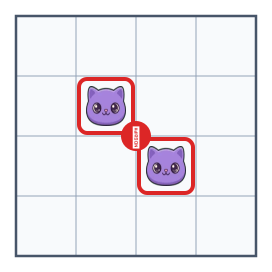
Run a one-second check before every tap
You only get three hearts, so a quick habit pays for itself. Before committing a cat, glance at four things:
- Is there already a cat in this row?
- Is there already a cat in this column?
- Does this region already have its cat?
- Do any of the eight surrounding cells — corners included — hold a cat?
Four checks, one second, zero wasted hearts. It feels slow for the first few boards and then becomes automatic.
Sweep the endgame
With a few cats left, switch to a checklist. List the rows and columns that no cat has used yet, then match each remaining region against them. A region that can only reach one unused row or column gives you a forced placement, and those last moves usually topple like dominoes once you line them up.
What to do when you're stuck on a Meowdoku board
Every board here has exactly one solution, so "stuck" always means one elimination is missing — not that the board needs a guess. Run this routine in order and stop at the first step that gives you a cat:
- Re-mark the board. For each placed cat, cross out its whole row, its whole column, the rest of its region, and the eight cells around it. Most stuck boards are missing a diagonal ✕.
- Count open cells per region. Find the region with the fewest. One open cell means a forced cat; two or three means the next check will usually settle it.
- Look for a line-lock. If a region's open cells all sit in one row or one column, that line is reserved for it — cross the line out for every other region and re-count.
- Match leftovers. List the rows and columns with no cat yet and pair them against the regions still empty. A region that can reach only one unused line is forced.
- Suspect an early cat. If none of the above moves, a cat you placed "by feel" is probably wrong. Take off the least certain one and re-run the list.
Meowdoku hints, explained
A good hint is not a free cat. It names one cell and the one rule that forces it — "the only open cell left in the pink region", or "the only cell in row 4 that doesn't touch a placed cat". That is exactly what the ✕ mark lets you produce yourself: cross out everything the current cats forbid, and whichever cell is left alone in its region is the hint.
If you do take a full reveal somewhere else, replay the board afterwards without it. The answer is the least useful part of a hint; the deduction behind it is what makes the next board faster.
Practice it on a live board
Techniques stick when you use them. Here is a real board — try working the most constrained spot first, then hunt for a line-lock:
Tap a cell to cycle empty → ✕ →  . One cat per row, column & color region — and no two cats may touch, not even diagonally.
Meowdoku strategy: frequently asked questions
- How do I get better at Meowdoku?
- Stop scanning the board at random. Always work the most constrained spot first — the smallest region or the tightest row or column — and after every placement, mark the cells that are now impossible. Forcing one move usually exposes the next, so the board unravels in a chain instead of a guess.
- How do I solve Meowdoku without guessing?
- Every board has a single solution reachable by logic, so a guess always means you missed an elimination. When you feel stuck, switch from asking 'where does a cat go?' to 'where can a cat NOT go?' — mark those cells, and a forced placement almost always appears.
- What is the best Meowdoku strategy?
- Region line-locks are the highest-leverage technique: when a region's only open cells share one row or column, that whole line is reserved for it, letting you eliminate every other region's cell in the line. Combine it with adjacency cascades and you can clear most boards without a single guess.
- Why do I keep losing hearts?
- Almost every lost heart is the diagonal-touch trap: two cats on different rows and columns that still touch at a corner. Before you place a cat, run a one-second check — its row, its column, its region, and all eight neighbouring cells, diagonals included.
- What should I do when I'm stuck on a Meowdoku board?
- Don't place a cat on a hunch. Re-mark every cell your placed cats already rule out (row, column, region, and the eight neighbours), then look at the region with the fewest open cells left. If that region's open cells all sit in one row or column, that line belongs to it — cross it out for every other region. One of those two checks exposes the forced move on almost every board.
- How do Meowdoku hints work?
- A useful hint doesn't hand you a cat; it points at the one cell a rule already forces and tells you which rule. Give yourself that hint with the ✕ mark: cross out everything the current cats forbid, and the cell that is left alone in its region is the hint. If you take a full reveal instead, redo the board afterwards without it — the deduction is the part worth learning.
- How do I solve the harder 8×8 boards?
- Bigger boards reward negative-space thinking and endgame sweeps. Track impossible cells aggressively, watch for locked pairs (two regions confined to the same two lines), and near the end, match each remaining region against the rows and columns no cat has used yet to force the final placements.